MARCH 16, 2013 WORKDAY

Getting in Even Better Shape

Getting in Even Better Shape

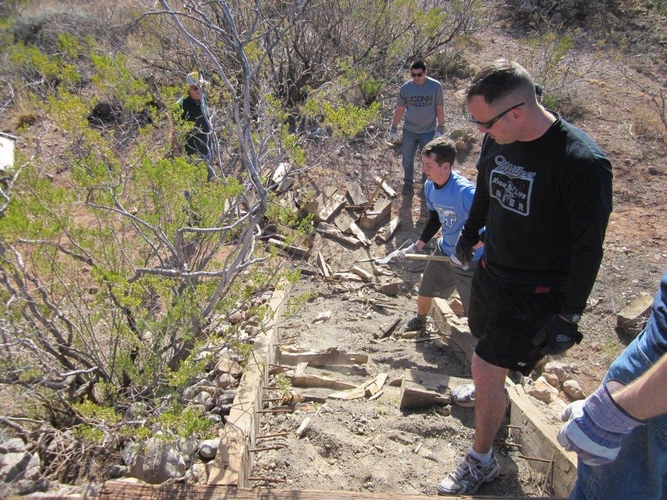
Wow what a wonderful day to work on a rail trail.  Sunny.  Warm.  Lots of help.  Twenty-four volunteers showed up, approximately half from Holloman Air Force Base.  Nothing like having a group of strapping folks ready and willing to work.  We claim that while helping us they are making themselves even more fit.  We even had a 10-year old volunteer.  Exciting.  Maybe we have gained another young hiker.  We had more folks than we were expecting, but the Forest Service brought plenty of trail working tools to keep everyone busy.

We concentrated on the Salado Canyon Rail Trail below High Rolls on CR A60. The Mexican Trestle up near Cloudcroft is more famous, but this trestle’s claim to fame is that you can walk on it and see and hear the tiny waterfalls from the year round creek underneath.  You can see most of the trestle in the photo below.
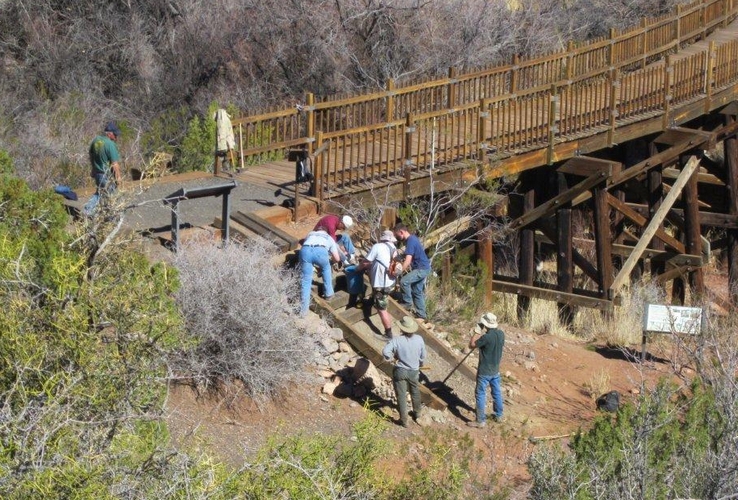
Working at the Trestle Steps

Working at the Trestle Steps

One team enjoyed the soothing sounds while replacing the stairs leading down to the interpretive sign.  The original 10 steps, installed in 2006, were not made of railroad ties, and even though they were treated periodically and are in an arid climate they still weathered poorly.  We were able to reuse the 9-inch nails and the 4-inch wide side rails used in the original construction.  Now fitted with new railroad ties the steps are in fine shape.  If you mosey on down that way to the sign you can see in the right side of the photo, you can learn about the names of all the lumber that makes up a trestle.

41 Steps Staircase a Quarter Mile From the Trailhead

41 Steps Staircase a Quarter Mile From the Trailhead

The second team hiked a quarter-mile to the 41-step stair case and replaced three steps.   It’s not easy working on such a steep slope.  Just carrying the equipment up the stairs is a good workout.

By the way hikers this is a good place to work on the cardiovascular aspect of hiking.  If you can get up the steps without gasping and wheezing, you are doing good.  The more hardcore hikers have been known to tread it multiple times.

Whacking Brush

Whacking Brush

Although it wasn’t planned, with such a large number of volunteers, a team was able to groom the seldom maintained quarter-mile trail past the trestle.  They cleared brush from the trail bed, trimmed brush to make the trail a certain width, and filled in holes.   It wasn’t easy.  After years of low rainfall the ground is like concrete.

This section of the trail bed is a “trail to nowhere” since it ends at private property.  (NMRTA hopes to change that in the very near future.)  There is no actual End sign.  [CORRECTION: Private property begins about 370 yards past the small broken trestle. ] The team cleared from the big trestle to about halfway to the end.  So right now the trail is in unusually good shape for walking and sightseeing.  Come on.  Keep walking.  Who knows what you might see.

Finally, another team helped the Forest Service “hide” access to some unwanted “shortcut” trails.  Some of the trails you will see are not man-made.  Cattle and wildlife trails crisscross the hiking trail and they have shown they can get up and down easier than two-legged critters.  If you take one of those trails, you might find yourself going somewhere rougher and pricklier than you expected.  So when there is a row of rocks or a shrub branch across a smaller path that means don’t go there.

At noon all volunteers dispersed.  We hope that the same number show up next month at the next workday.  News will be posted at this site about a week before the day.  And don’t forget.  Come out and hike the Salado Canyon Rail Trail before it gets hot.
WHAT A GREAT FEBRUARY 2013 WORK TEAM

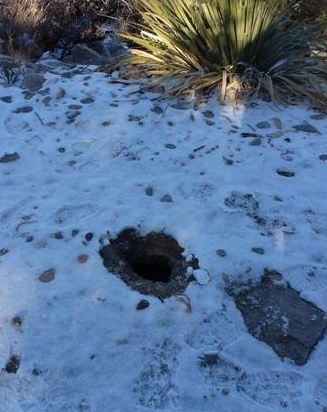
Hole in the culvert

The Hole That Started it All

This last workday began long before volunteers picked up hammers on February 23rd.  Planning began in September 2012 after a Grand View Trail hiker and NMRTA member, reported a 5-inch hole in the trail immediately over a wooden culvert.  It wasn’t big, but it was dangerous to hikers.

The wooden culverts, built to allow rain water to flow under the rail beds, were built by railroad workers over 100 years ago which makes them archeologically significant, so NMRTA couldn’t just hammer new boards on.  After considerable review, inspections, and collaboration, the Forest Service allowed NMRTA to proceed with replacing the culvert due to it’s overall deterioration…as long as the replacement was identical to the original.

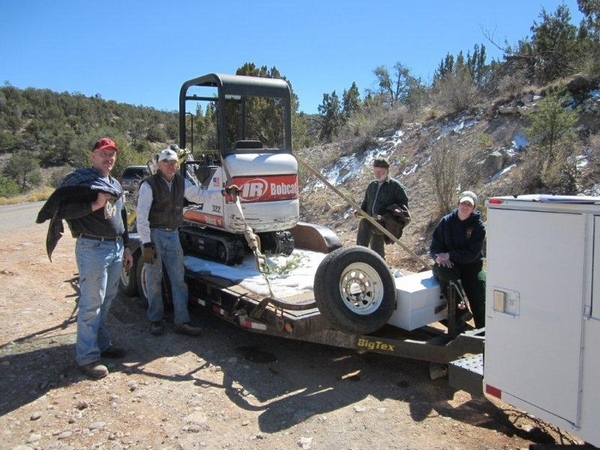
With that requirement in mind, NMRTA special ordered about 150 feet of 3 inch x 12 inch treated lumber and over 200 six inch nails.  After delivery, handy NMRTA volunteers pre-cut the lumber.  Two days before the workday, two volunteers braved the cold and frozen ground to deliver the lumber, dig up the culvert, and prepare the trench to accept the new culvert.  The loan of a Forest Service Bobcat made the task so much easier.

On the workday, eight volunteer trail workers met at 8 a.m. at the lower trail head of the Grand View Trail.  They made their way up-trail a quarter mile or so to the work site, accompanied by  two pickups with tools and supplies.  Talk about a neck ache!  The pickup drivers had to back up over half the distance  due to limited turn-around opportunities on the  narrow railroad bed.

Hammering and more hammering

Working on Those Arm Muscles

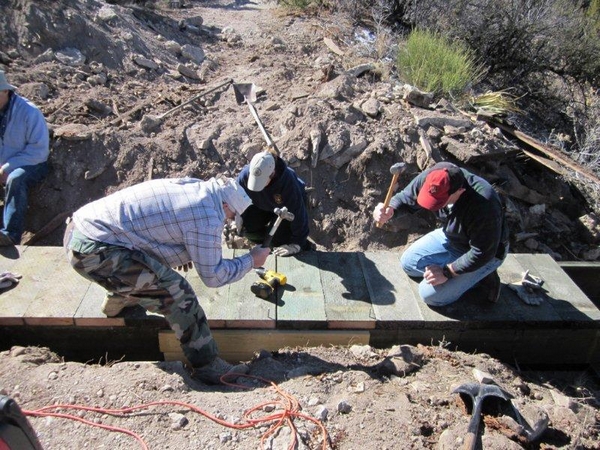
The trail workers arrived at a very big trench and a pile of cut wood.  Construction should have been simple.  After all a culvert is basically a big, heavy box.  However, it was too heavy to build in one piece so construction began with building one-half of the bottom and sides.  That assembly, weighing about 300 lb, was inverted and set into the trench.   After the second half was assembled and set into the trench, the two halves were spliced together and the roof pieces nailed into place.  Yep, they brought out the big hammers to drive the 6-in. nails.  In between all the cutting and hammering, a volunteer drenched the fresh cuts with a wood preservative.  There were some sore shoulders by the time the last nail went in.   Lastly, the handy, dandy Bobcat was used to cover the new culvert.

Tired but happy volunteers

Tired But Happy Volunteers

And while the culvert construction was taking place, one volunteer was back at the entrance treating the entire stile with wood preservative.

By 12:15 pm, all work had been completed, the workers had returned to their cars  and the Bobcat re-loaded on to its trailer.  It had been a good workday.  Cost of materials…less than $1000.  Cost of manual labor from generous volunteers…priceless.

The trail is ready to be trod on so come on out to Grand View Trail and walk all over our work.

FROM THE GRAND OPENING

Great weather.

Great visitors.

Great volunteers.

For those of you who couldn’t make it to the US Forest Service and NMRTA grand opening of the Bridal Veil Falls Rail Trail on October 27, 2012, here are some pictures.

Marcie Kelton, of the U.S. Forest Service, speaking to the crowd.

Marcie Kelton, of the U.S. Forest Service, speaking to the crowd.

US Forest Service representative, Marcie Kelton, warmed up the crowd.

Grady Nicholson, president of NMRTA, addresses the crowd.

Grady Nicholson, president of NMRTA, addresses the crowd.

President Nicholson, looking like he was going to out-hike everyone, said a few words.

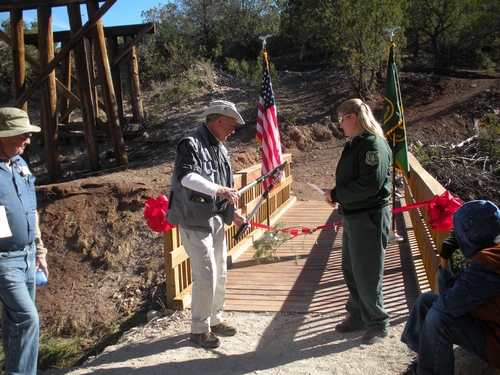
Nicholson and Kelton cutting the ribbon.

Nicholson and Kelton cutting the ribbon.

Quick cut the ribbon or we’ll be run over by impatient hikers.  Already had two trail runners zip under the ribbon!

Crossing Crowd

Crossing Crowd

Of course, the star of the opening was the crossing itself.  What a difference this crossing has made.  There is something about all the green grasses and flowing, gurgling water that just pulls people to this site.  Eight months ago if you walked this part of the trail, you picked your way carefully through rocks and brush down a 45-degree angle, jumped the incredibly cold, muddy-sided stream, and ascended equally difficult terrain to a very narrow trail.  This wet crossing was the most difficult walking spot on the whole trail, a bottleneck for those who couldn’t take extreme terrain.  Not only did the work crews build a crossing over the steepest area, they also worked on either side of the crossing making the trail at least 3 feet wide, less steep and very stable.  We hope those of you who haven’t walked the trail because of this spot will come on out and enjoy more of the great outdoors.

Crossing Construction Photos

Crossing Construction Photos

For those who haven’t been seeing our workday photos, here they are to show the stages of crossing construction.  Volunteers spent many hours carrying and tossing rocks, moving dirt, carrying construction materials and building.

GPS Raffle Winner

GPS Raffle Winner

Knowing everyone would stop at the falls, volunteers handed out water and munchies.  Draney Orchard donated boxes of fresh-off-the-trees apples.  In the photo above, Board Member Susan Wheatley, who donated a Garmin eTrex gps, congratulates the raffle winner.  The crowd showed off their good sportsmanship by not chunking rocks at the lucky man.

What the pictures didn’t show were the many volunteers who made this day possible.  Three fire departments responded and Holloman Air Force personnel directed traffic.  Four High Rolls/Mountain Park businesses, High Rolls General Store, The Tunnel Shop, Rustic Log Cabin, and The Apple Barn discounted selected purchases when hikers arrived sporting an Opening tag.  High Altitude, a Cloudcroft outfitting business, provided the parking shuttle.

All in all it was a great day.  For those of you who made it, thank you.  For those of you who didn’t, come on out, the trail is open and fine.